
The "Spend First, Save Later" Reality: What New Data Says About How Young South Africans Actually Budget
New 2026 data reveals how young South Africans really budget — and why saving later in the month isn't a mistake. Free 50/30/20 calculator inside.


If you get paid, spend most of it in the first week, and only manage to put money away somewhere around the middle of the month — you're not doing it wrong. According to Standard Bank's 2026 Youth Barometer Report, developed with Youth Dynamix, this is the norm for South Africans under 35, not the exception. The data shows spending peaks sharply on payday, essentials get settled first, and saving activity only really picks up between the 12th and 20th of the month — once the non-negotiables are out the way. Understanding this rhythm is the first step to working with it, instead of feeling like you're failing every time you don't save on the 1st.
The Payday Curve: What Happens to Your Money in the First 24 Hours
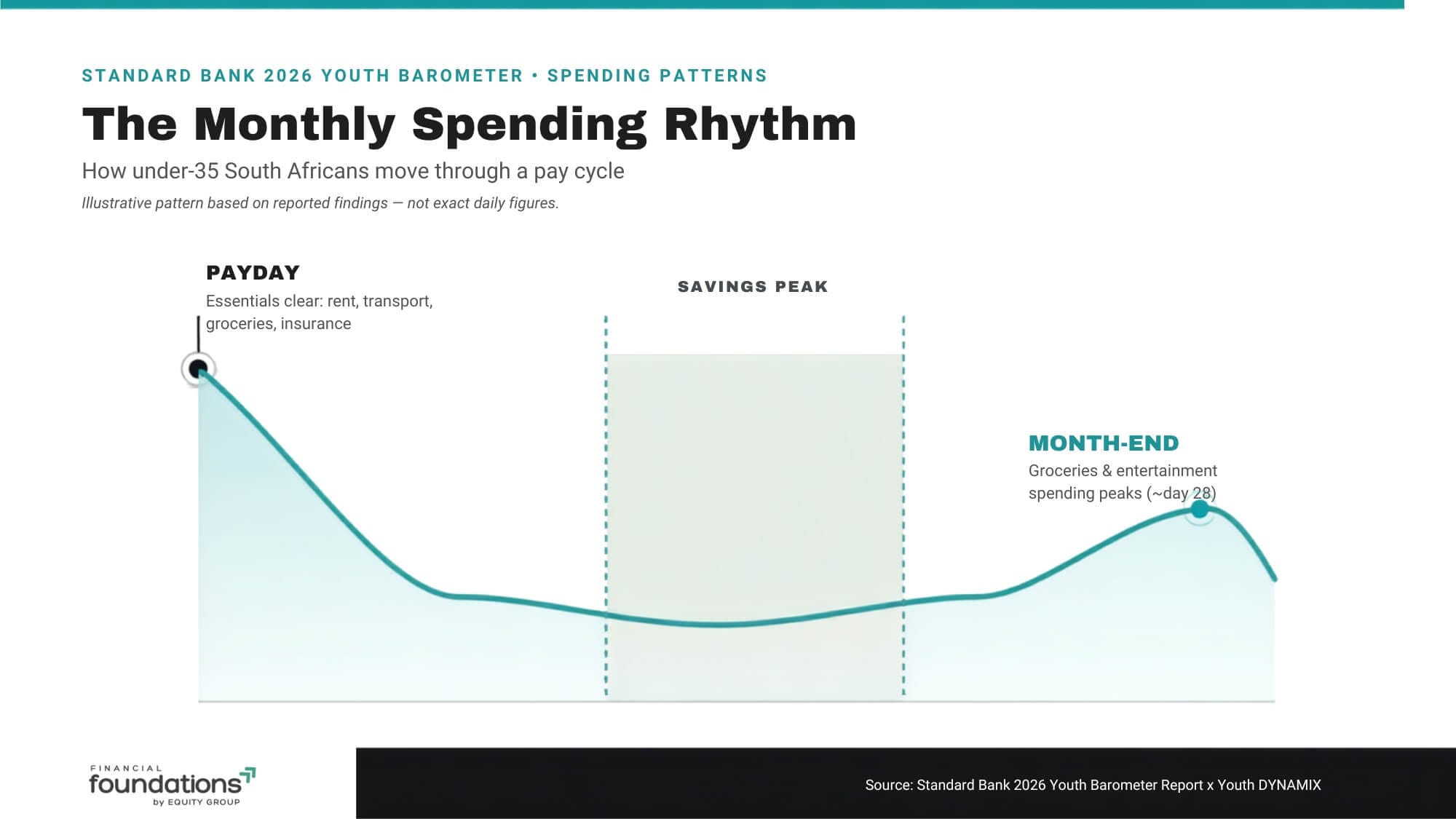
The data paints a very consistent picture. The 1st of the month records the highest average daily spend of any day, and it drops off sharply from there. That's not impulsive spending — it's largely essentials clearing your account all at once: rent, loan repayments, groceries, transport, insurance. Payday functions as a financial reset point. The fixed costs get paid first, almost automatically, and whatever's left gets stretched across the rest of the month.
For younger South Africans still building a career, this pattern shows up a little differently. Spending tends to weight more heavily toward groceries and entertainment, both peaking again toward month-end — around the 28th — as pay cycles and allowances line up with weekend plans, lifestyle spending, and topping up essentials before the next payday arrives.
None of this is evidence of poor discipline. It's evidence of a system where fixed costs are non-negotiable and have to be handled first, whatever's left over gets used to keep life running, and only once both of those are sorted does anyone have headspace to think about saving.
Groceries vs Takeout: The Real Story Behind "Failing" to Save
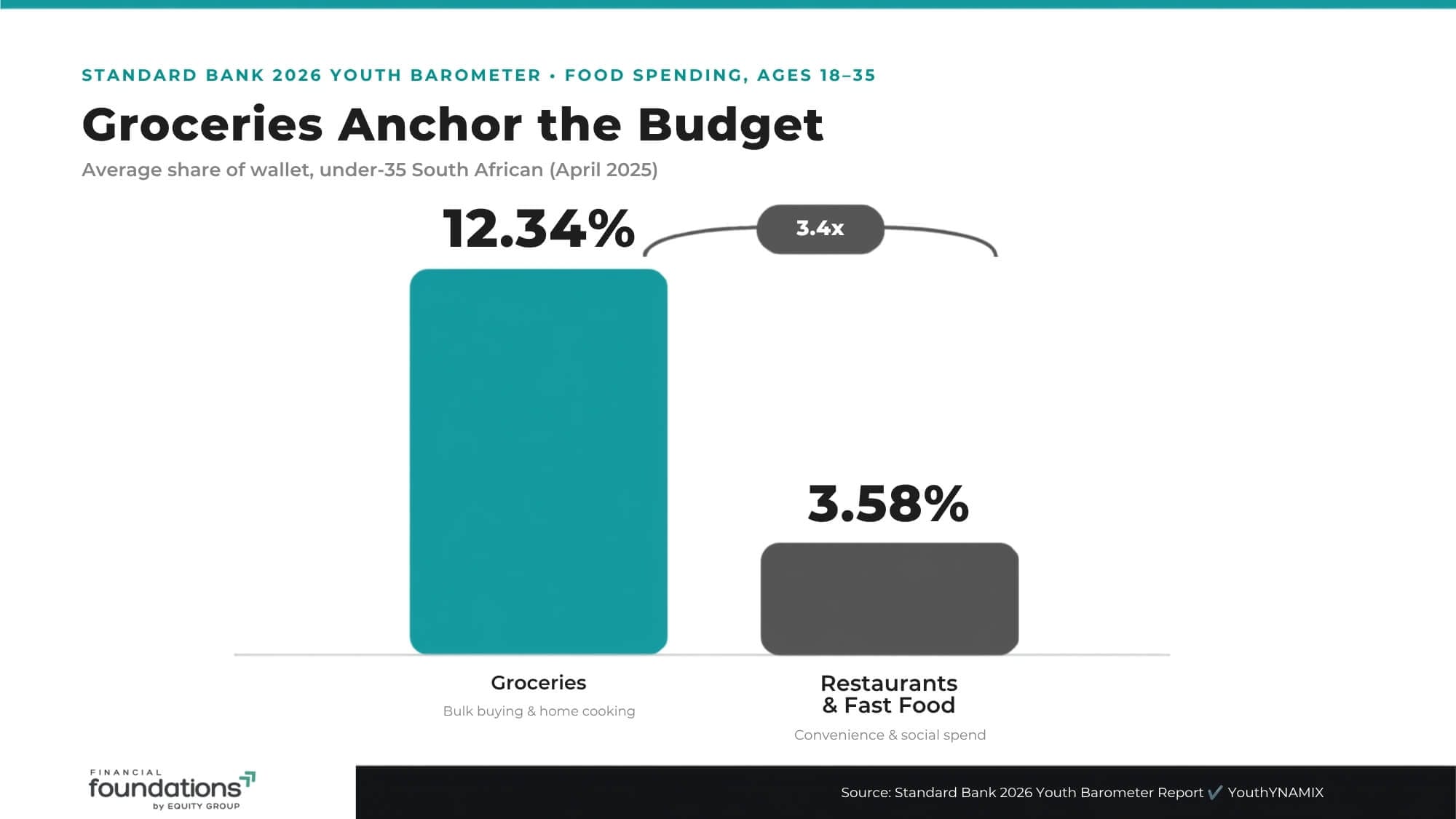
One of the clearer findings in the report cuts against a common assumption — that young people spend recklessly on convenience and takeaways instead of cooking at home. The data doesn't support that.
Across the 18–35 age group, grocery spending consistently and significantly outweighs restaurant and fast-food spending — on average, groceries account for well over three times the share of wallet that eating out does. Groceries are driven by cost-consciousness: bulk buying, home cooking, and budget management. Eating out plays a different, smaller role — convenience, social connection, and the occasional reward, not a replacement for the weekly shop.
Where restaurant and takeaway spending is elevated, it's typically among younger consumers aged 18–24, where convenience and social activity carry more weight day to day. As people move through their late twenties and into their thirties, food spending becomes more balanced and predictable, with groceries firmly anchoring the budget and restaurant spend playing a smaller, more occasional role.
The takeaway here: if your grocery bill dominates your budget and takeaways feel like a rare treat rather than a daily habit, you're already doing the "boring but effective" part of budgeting that most financial advice assumes people aren't doing.
Why Saving Happens Mid-Month (And Why That's Not a Character Flaw)
Here's the part that should take some pressure off. Savings activity in the data is concentrated in the middle of the month, peaking most strongly between the 12th and 20th — well after payday, and only once major expenses and financial obligations have already been addressed.
It would be easy to read this as a "spend first, save later" problem unique to younger South Africans, and evidence of a short-term mindset. But the report is explicit that this pattern isn't unique to youth at all — broader analysis of Standard Bank's client base shows the same mid-month peak in savings activity, regardless of age. In other words: most South Africans, not just those under 35, save what's left over after the essentials are covered, rather than setting money aside the moment they're paid.
This is a meaningful distinction. It means the common "pay yourself first" advice — while sound in principle — doesn't reflect how most people are actually able to operate, especially early in their careers when income is tighter and margins are thinner. Saving mid-month, after obligations are met, isn't a discipline failure. It's the practical reality of managing a budget where fixed costs come first.
Savings behaviour is also seasonal — the data shows clear increases around December and other bonus-linked periods like February, March, and November, which lines up with festive spending, back-to-school costs, and 13th-cheque or bonus timing for those who receive one.
Flipping the Order: A Practical Way to Apply the 50/30/20 Rule
If saving genuinely tends to happen after essentials and lifestyle spending rather than before it, the most useful move isn't to fight that pattern — it's to build a structure around it so "later in the month" still reliably happens, rather than quietly not happening at all.
A simple way to do this:
- Pay the non-negotiables first, in the first few days after payday — rent, debt repayments, insurance, transport.
- Set a specific mid-month date — the 15th works well, based on where the data shows saving naturally peaks — to move a set amount into a separate savings pocket, before it gets absorbed into general spending.
- Let discretionary spending flex around what's left, rather than the other way around.
This is essentially the 50/30/20 principle — needs, wants, savings — but sequenced to match how income and spending actually move through the month, rather than assuming everyone can save the moment they're paid.
If you want to see exactly how your own numbers break down against this, Equity Group's free 50/30/20 calculator does the maths for you — no email required, no judgement about where your money's currently going.
Frequently Asked Questions
How much should I save each month in South Africa?
There's no single fixed amount — it depends on income and fixed costs — but a widely used starting point is the 50/30/20 rule: roughly 50% of income toward needs, 30% toward wants, and 20% toward savings and debt repayment. If 20% isn't realistic yet, even a smaller consistent amount set aside mid-month, after essentials are paid, is a solid starting habit.
Is it bad to save after paying my expenses instead of before?
No. Data from Standard Bank's 2026 Youth Barometer Report shows this is the norm across South African consumers of all ages, not just younger people. What matters more than the timing is consistency — building a habit of setting money aside once obligations are met, rather than treating savings as whatever happens to be left at month-end.
What percentage of income should go to groceries vs eating out?
There's no fixed rule, but the data shows groceries typically account for a far larger share of spending than restaurants and takeaways among South Africans under 35 — often more than three times as much. If your grocery spend already dominates your food budget, that's a healthy pattern worth keeping.
Sources: Standard Bank 2026 Youth Barometer Report, in partnership with Youth Dynamix.