
How Under-35s Are Actually Using Credit Cards: Why High Usage Isn't the Same as Financial Trouble
New 2026 data shows young South Africans repay credit cards 3+ times a month. Here's what high credit card usage really means for your credit score.


If you regularly use 70% or more of your available credit card limit, it's easy to assume that's a warning sign. According to Standard Bank's 2026 Youth Barometer Report, it's actually the norm for South Africans under 35, and on its own, it doesn't indicate financial distress.
What matters far more than how much of your limit you're using is how often you're paying it back. Young South Africans repay their cards more frequently than any other age group, and it's that repayment behaviour — not the utilisation number — that tells the real story.
It makes you think of the old song The Kids Are Alright", the classic 1965 rock song by the English band The Who.
The Real Story Behind 70%+ Utilisation
The data shows credit card limit utilisation among under-35s sitting consistently between 70% and 73%, depending on age band, noticeably higher than older cohorts, where utilisation gradually declines with age, down to around 47% for consumers over 60.
On its own, that comparison looks like young people are stretched thinner. But utilisation is only half the picture. Under-35 consumers also make an average of 3.2 to 3.5 credit card repayments per month. Again, more frequent than every older age band in the data. Balances are being used continuously and paid down continuously, rather than built up and left to sit.
This lines up with a broader shift in how credit cards are being used. Older generations have tended to treat a credit card as an emergency tool or a way to finance a large, occasional purchase. Younger consumers are using it more like a transactional tool woven into everyday spending - helping manage cash flow, track spending digitally, and build a credit history, rather than functioning purely as a source of debt.
It's worth noting that under-35s make up only 16% of Standard Bank's credit card customer base, yet account for 29% of total digital wallet usage and nearly 30% of virtual card adoption — more than double the rate seen among consumers over 60. High utilisation paired with heavy digital engagement points to a generation actively managing their cards through banking apps, not one that's lost track of their balance.
What Financial Trouble Actually Looks Like, And What the Data Shows Instead
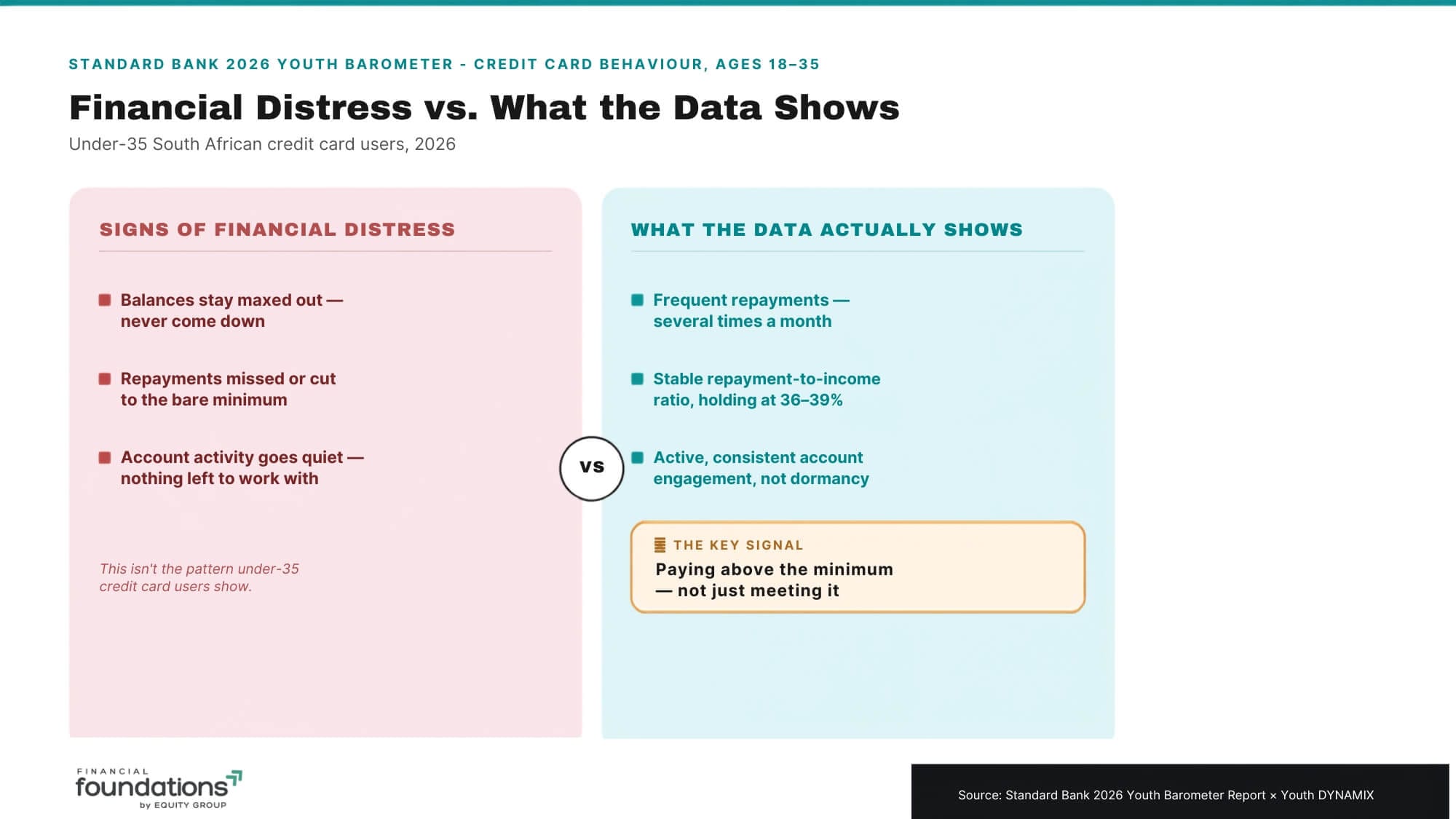
There's a meaningful difference between using a large share of your credit limit and being in financial difficulty, and the data draws that line clearly.
Consumers genuinely in financial distress tend to show a consistent pattern: balances that stay maxed out and never come down, repayments that are missed or reduced to the bare minimum, and account activity that goes quiet because there's nothing left to work with.
What the data shows among under-35 credit card users instead is close to the opposite: frequent repayments, made several times a month; stable repayment-to-income ratios, holding steady at around 36–39% across the age bands; consistent, active account engagement rather than dormancy; and — notably — many repayments made above the minimum amount due, not just the minimum required to stay in good standing.
That last point matters. Someone in genuine difficulty pays the minimum because it's all they can manage. Someone managing their card strategically pays more than the minimum because they're actively trying to keep their balance — and their credit profile — healthy.
What Under-35s Are Actually Buying With Credit
If credit cards were mainly funding lifestyle upgrades or big discretionary purchases, you'd expect to see that reflected in where the spending goes. It isn't. The top merchant categories for under-35 credit card spending are grocery stores, fuel, restaurants, clothing retail, and pharmacies — in short, the same categories that make up ordinary monthly living costs for anyone.
Bigger, less frequent purchases — travel, home furnishings, appliances, vehicle-related spend — do show up in the data, but they sit well behind everyday categories and tend to be linked to specific events (a trip, moving house, starting a course) rather than an ongoing pattern of financing a lifestyle beyond one's means.
The practical read here: many under-35 consumers are using their credit card the way it's designed to be used for cash flow management — covering routine expenses in the period between paydays, and settling the balance as income comes in — while also picking up the side benefits of rewards, cashback, and the fraud protection that comes with paying by card rather than cash or EFT.
Where Buy Now, Pay Later Fits In
One more piece worth understanding: Buy Now, Pay Later (BNPL) usage is most common among younger consumers, typically for clothing, retail purchases, digital products, and electronics. It isn't replacing credit cards — the data shows it functioning alongside them, absorbing shorter, smaller retail purchases while credit cards continue to carry everyday essential spending.
The genuine risk with BNPL isn't the product itself, it's what happens when several BNPL agreements run at the same time. Because each one feels small and manageable on its own, it's easy to end up with three or four simultaneous repayment obligations that, added together, quietly eat into what you can actually afford — a pattern sometimes called instalment stacking. If you're using BNPL, the simplest safeguard is keeping a running tally of every active agreement in one place, rather than judging affordability one purchase at a time.
A Quick Way to Check Where You Stand
If you want a rough gut-check on whether your credit card use looks more like the "actively managed" pattern in the data or something worth paying closer attention to, ask yourself:
- Am I paying more than the minimum, most months? Consistently paying only the minimum is one of the clearest signals worth acting on.
- Is my balance roughly the same size (or shrinking) six months from now compared to today, even with regular spending on it?
- Do I know exactly how many BNPL or credit agreements I currently have running at once, and what they add up to per month?
If any of those give you pause, it's worth working through the numbers properly rather than guessing. Equity Group's free Financial Health calculator can help you see exactly where your repayments sit against your income — no email required.
Frequently Asked Questions
Does using a lot of my credit limit hurt my credit score?
High utilisation on its own isn't automatically harmful, especially if you're repaying consistently — Standard Bank's 2026 data shows under-35 South Africans using 70%+ of their limits while repaying more frequently than any other age group. That said, keeping utilisation lower where possible, alongside consistent repayment, generally supports a stronger credit profile over time.
How often should I repay my credit card?
There's no single required frequency, but the data shows younger South Africans repaying an average of 3 to 3.5 times a month — often aligned with payday, income changes, and the need to manage day-to-day cash flow. Paying more frequently, and above the minimum where possible, tends to reflect — and support — healthier credit management.
What's the difference between using credit for cash flow and being in debt?
Using credit for cash flow means spending on your card for routine expenses and repaying the balance regularly as income comes in, keeping your balance broadly stable over time. Being in debt typically looks like a balance that keeps growing, repayments dropping to the bare minimum, and little ability to bring the balance down even after repayment. The clearest signal isn't how much of your limit you use — it's whether your balance is stable or climbing over several months.
Sources: Standard Bank 2026 Youth Barometer Report, in partnership with Youth Dynamix.